How to Plan Your First Outdoor Holiday (Without Wasting Money on Gear)
Last modified on 6 Jun 2026
Reading time 7 minutes
Want to try wild camping but don't know where to start? Learn how to take your first outdoor holiday, prepare your fitness, and choose the right beginner trail.
The idea has been there for a while
You've scrolled past the photos enough times. Someone standing at a viewpoint that looks unreal. A campfire at the edge of a lake with no-one else around. A hammock strung between two trees somewhere that looks nothing like your commute.
The thought arrives and then the thought leaves. Because the gap between wanting to do something like that and actually doing it feels large and the gap seems to be filled with questions you don't have answers to yet.
What gear do you need? How fit do you need to be? Where do you even go? Is it safe to do it alone? Do you need experience to enjoy it, or do you need to enjoy it to get experience?
This article is for that version of you, the one who wants to go but hasn't gone yet. It's also, by the end of it, going to make the decision feel significantly simpler.
Let's acknowledge the real blockers
There are a few things that reliably stop people from taking an outdoor adventure holiday for the first time.
The gear problem
Walk into an outdoor shop, or worse, spend 20 minutes on Reddit's camping communities, and you'll quickly feel like you need to spend hundreds of euros before you can even consider going outside. Sleeping bags with ratings you don't understand. Boot waterproofing technology. Water filtering systems.
Most of this is real, but almost none of it needs to happen before your first trip. The gear industry has a vested interest in making you feel underprepared. The truth is that the most important thing is getting out. Gear refinement happens afterwards, once you know what you actually need. It’s good to have some essentials, but refinement comes later.
The fitness question
'Am I fit enough?' is a question that keeps more people at home than any gear shortage. The answer, for most people considering a guided multi-day outdoor trip, is probably yes, with one condition. You need to walk. Not sprint, not train for months, but walk with some consistency in the weeks before the trip.
Multi-day outdoor trips are not races. Guided trips specifically are calibrated to a pace that allows the group to move together. There are rest stops. There is no shame in being the person who takes the break.
The solo problem
The idea of going alone is what stops a significant number of people. Not because the trip itself requires a partner, it doesn't, but because the social uncertainty of arriving somewhere unfamiliar, with strangers, and sleeping in the outdoors together, feels like a lot.
This is the paradox of small-group adventure trips: the thing that feels most daunting about them, the strangers, turns out to be one of the most valuable parts. There's a social chemistry that happens when a small group of people share a physical challenge with no digital escape route, and it consistently produces the kind of conversations and connections that don't happen in normal social settings.
What a guided trip actually handles (so you don't have to)
The reason that a guided outdoor trip is the right first step, rather than planning something solo, isn't a lack of confidence. It's an efficiency argument.
When you go with a good guide on a well-designed route, the following things are already solved:
- Route planning and navigation
- Campsite selection and permits
- Food planning and preparation
- Safety and emergency protocols
- Gear provision
- The social dynamic that makes the experience enjoyable rather than lonely
What you're left with is the actual experience, the walking, the landscapes, the conversations, the nights outside. Which is, of course, the only part you wanted in the first place.
On every Hammock Haven trip, all the necessary hammock gear is provided. On the Hammock Trail Sweden, a food pack is available as an add-on (highly recommended — more on that shortly). On both Albanian trips, North and South all food is included in the trip price, as are activities like kayaking in the north and rafting on the Vjosa river in the south. Transport from the moment you land in Albania is taken care of. In Sweden, the group is picked up in Arvika, the starting point of the trip. You arrive. Everything else is handled.
Hammock camping specifically, why it's the right format for a first trip
If you've never camped in a hammock, the concept might sound either extremely appealing or slightly absurd. Both reactions are understandable.
There's no groundwork
Finding flat, stone-free, dry ground for a tent is genuinely difficult. A hammock requires two trees at the right distance apart. In any forest, this takes about 90 seconds. The setup is faster, the result is more comfortable, and the packing down is clean.
The sleep is better than you'd expect
Most adventurers who try hammock camping for the first time report sleeping better than they expected. The gentle suspension reduces pressure points, the elevation keeps you clear of ground moisture, and there's something about being cradled by the forest that makes the nervous system settle. Ask anyone who's done it.
It's genuinely low-impact
No site clearance, no soil compaction, no lasting marks. If Leave No Trace principles matter to you, and they increasingly matter to the kind of traveller we're talking about, hammock camping is a very ethical way to sleep in nature.
It changes the morning
Unzipping a tent and stepping onto wet grass is fine. Lying in a hammock and watching the light change through the canopy above you, with a coffee, before the day starts, that's a different morning entirely. It's the morning that makes you understand why adventurers do this.
How to prepare (without overcomplicating it)
Walk more than you think you need to
The single best preparation for a multi-day walking trip is walking. Specifically, walking with a loaded backpack, uphill, for longer than is comfortable. You don't need a training plan. You need to do this several times in the four weeks before the trip.
Break in your boots/trailrunners
New boots on a long trail are a reliable source of misery. Whatever footwear you use, trail runners or hiking boots, they need to have been worn enough that your feet and the shoe have reached an understanding. This takes at least 20–30 hours of wear.
Sleeping gear, what's provided
Hammock Haven provides the hammock, underquilt, and top-quilt as an add-on option for the trip. The system is rated to a comfort temperature of 5°C and a maximum rating of -1°C, which is more than sufficient for the seasons both routes run in. If you already own a sleeping bag or top-quilt you're happy with, you're welcome to bring it, just check that it meets those temperature ratings. You don't need to buy anything new.
Pack light and mean it
The packing advice you'll read everywhere is to pack what you need, then remove half. It's annoyingly accurate. Every gram you carry over the course of a week becomes a meaningful cumulative weight. If you haven't used it in the last 24 hours of a trip, you probably didn't need it.
Choosing the right first trip
Not all guided outdoor trips are created equal, and the right first trip depends on what you actually want from it. Here's an honest breakdown of the three Hammock Haven routes:
Sweden, The Hammock Trail: Sweden
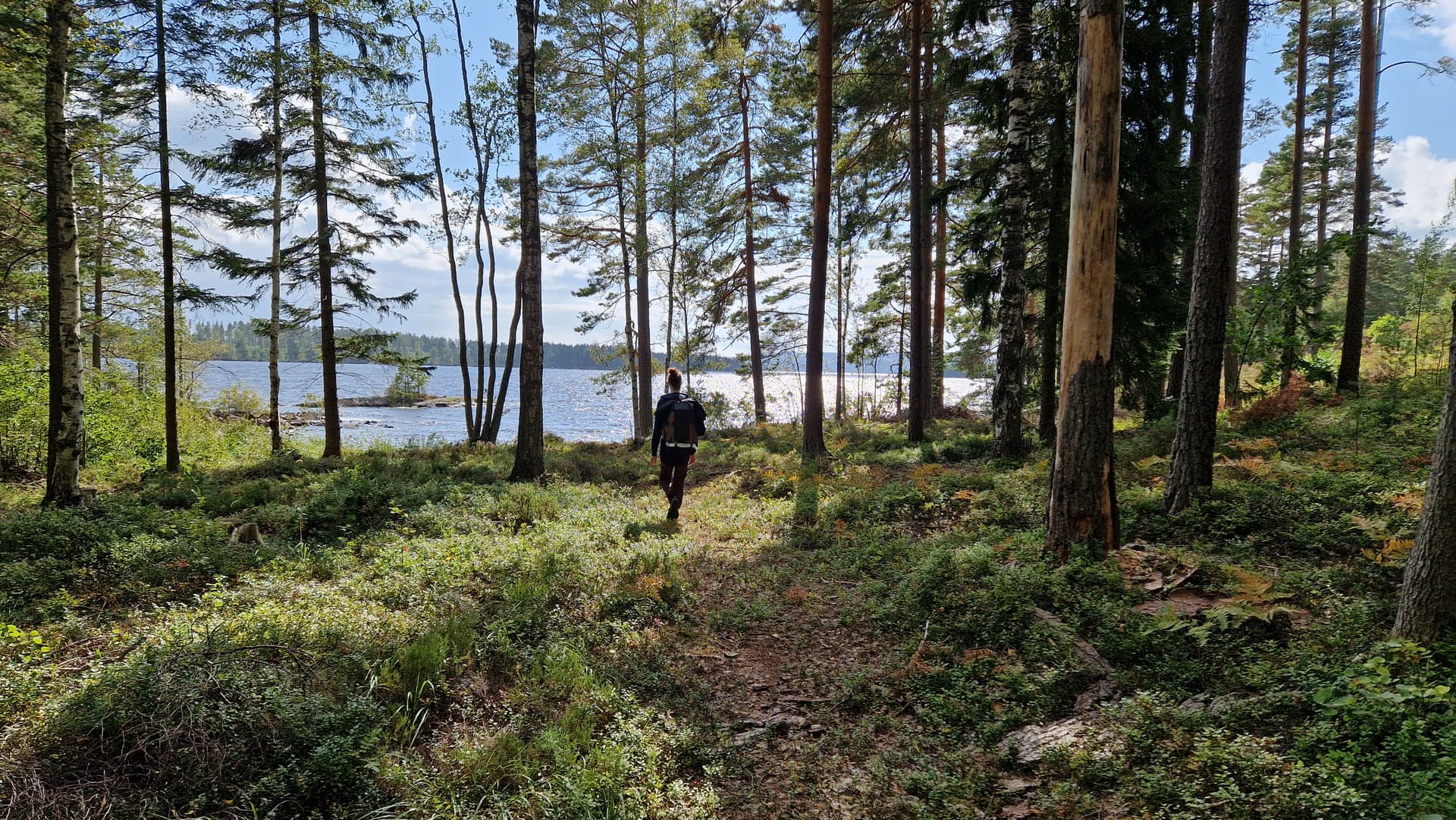
Rolling hills, lakes, swimming spots, blueberry forests, and little elevation. Around 9km per day with about 300m of elevation, the most beginner-friendly of the three trips we currently offer. Flexible daily distances and an optional free afternoon mean the trip adapts to the group. If you want to ease into wild camping in a landscape that is beautiful without being demanding, this is the right start.
Northern Albania, The Hammock Trail: Northern Albania
Rugged, high mountain terrain with serious elevation, around 13km per day and 1,850m of combined ascent and descent on average. Waterfalls, shepherds with sheep on the trail, kayaking as part of the itinerary, and dinner at a genuinely famous farm-to-table restaurant. If you want to be challenged and want the cultural layer to be as strong as the landscape, this is the adventure.
Southern Albania, The Hammock Trail: Southern Albania
Stretched remote landscapes, very little tourist infrastructure, deep cultural immersion, and rafting on the Vjosa, one of the last truly wild rivers in Europe. Around 11km per day with an average of 1,360m daily elevation. More remote and more authentically Albanian than the north. The right choice for someone who wants to disappear completely into somewhere that hasn't been packaged for visitors yet.
What comes after
The thing that experienced outdoor travellers know, and first-timers discover, is that the first trip changes the aperture. Not in a way that requires buying more gear or booking more expensive trips. Just in a way that recalibrates what's possible.
You come back from a week of sleeping outside and walking through landscapes that were entirely unfamiliar, and the version of you that was unsure whether any of this was really for them has a different relationship with uncertainty.
That's not a marketing promise. It's just what tends to happen when adventurers do something they weren't sure they could do, in a place they weren't sure they could get to, with adventurers they didn't know existed a week earlier.