7 Hammock Camping Mistakes First-Timers Make (And How to Fix Them)
Last modified on 23 May 2026
Reading time 9 minutes
Thinking about your first hammock camping trip? Learn how to avoid the 7 common mistakes beginners make, from proper sleep angles to picking the right gear.
The worries are real. So are the answers.
There's a specific kind of anxiety that arrives when you've booked an outdoor adventure trip and the departure date starts to feel close. It's not quite fear — you chose this, after all, and part of you is genuinely looking forward to it. It's more like a mental audit: a running inventory of everything that could go wrong, or be harder than expected, or turn out to be not quite what you imagined.
This is normal. It's also, almost without exception, disproportionate to reality.
The concerns that first-time hammock campers and outdoor adventure travellers carry into a trip are consistent enough across people and backgrounds that they can be listed, addressed, and largely put to rest before you arrive. What follows is that list — the honest version, from people who've been here before.
Worry #1: I won't be able to sleep in a hammock
This is the most common concern, and the one that most often surprises people on the other side of the first night.
The fear usually centres on the diagonal position, the unfamiliar suspension, or the general uncertainty of sleeping somewhere that isn't a bed. All of these are understandable. None of them tend to hold up past the first or second night.
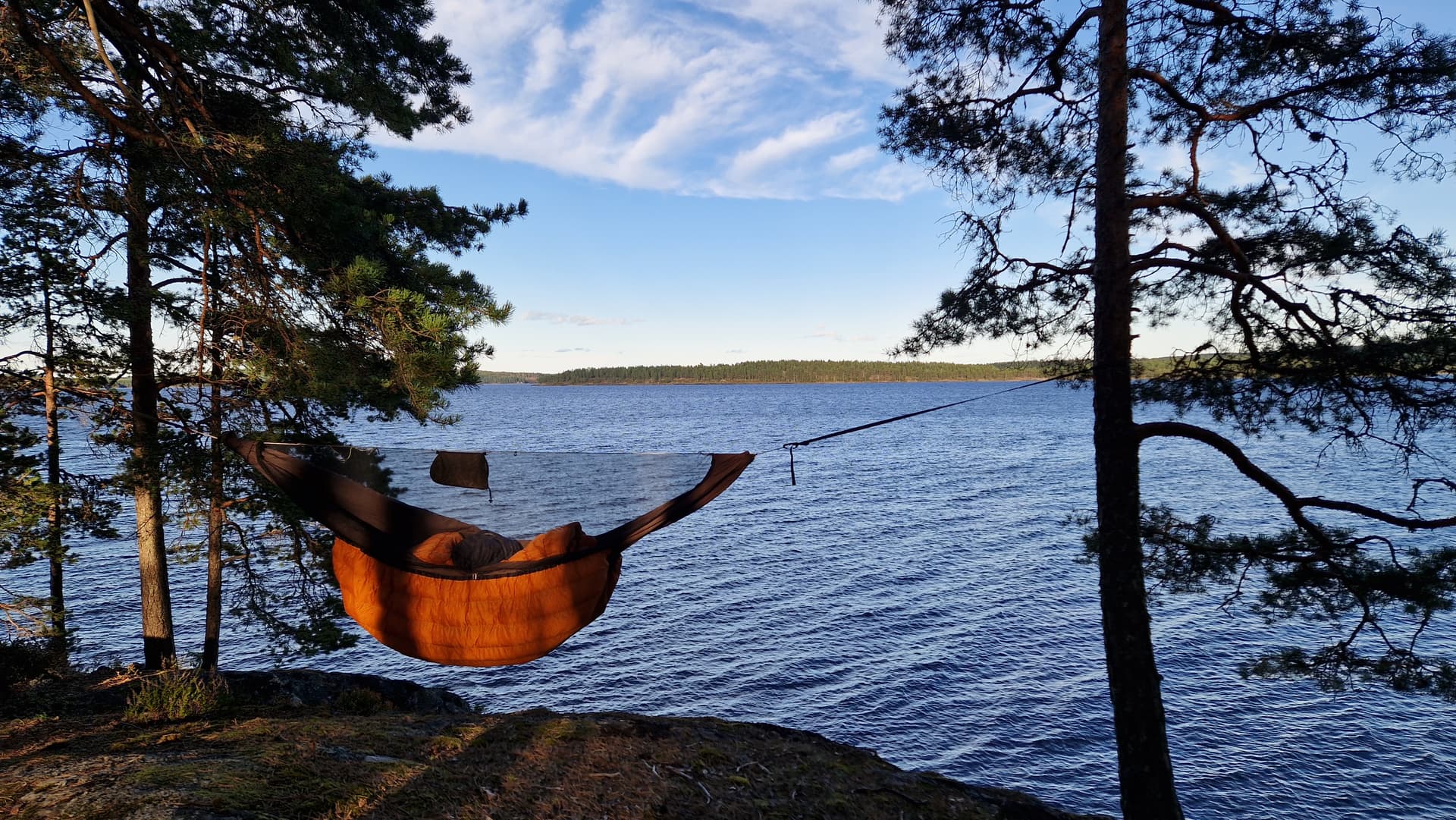
The key insight most people miss: a hammock is not designed to be slept in lengthwise, like a banana. The correct position is slightly diagonal, roughly 30 degrees off the centreline, which flattens the fabric beneath you and produces a genuinely flat, comfortable sleeping surface. In this position, the hammock isn't wrapping around you. It's supporting you evenly, with no pressure points, no damp ground contact, and no roots or rocks underneath.
Sleep quality in a hammock, for most people, improves noticeably from night one to night two, and again from night two to night three. By the middle of a week-long trip, the majority of adventurers describe it as the best sleep they've had in months. This is not a coincidence: physical exhaustion from hiking, clean air, genuine darkness, and the absence of screens create conditions that most people's bedrooms don't come close to replicating.
On the first evening of every Hammock Haven trip, the guides walk everyone through the full setup, hammock position, tarp rigging, and the self-made stick-locking system that secures the tarp knots in any weather. The hammock itself can be hung in under two minutes; the complete shelter setup takes around eight. After that first night, most people want to practise doing it themselves. The guides are there throughout the week to help where needed, but by day three it's second nature.
It was clear that Hammock Haven has a lot of experience with hammocking and hiking because all the little details were very well designed. The hammocks were very comfortable and easy to set up, pack and carry.
Worry #2: I'm not fit enough
Almost everyone who books an outdoor adventure trip, at some point in the weeks before departure, wonders whether they've misjudged their own fitness. This worry is especially common in people who exercise inconsistently, who know they're not unfit but also know they haven't been particularly consistent.
The honest answer: for a guided multi-day hiking trip at a moderate pace, what you need is not a high fitness level but a reasonable base. You should be able to walk for several hours without it being genuinely distressing. You don't need to be a runner, a cyclist, or a regular gym-goer. You need to walk, and to have walked with some regularity in the weeks before the trip.
What often surprises first-timers is how quickly the body adapts. Day one is typically the hardest; the pack feels heavy, the legs aren't yet calibrated to the terrain, and the mental adjustment to a full day of walking is still in progress. By day three, something shifts. The body has found its rhythm. The pace that felt challenging on day one feels natural. People who arrived uncertain whether they could do it discover that not only can they, they could do more.
A guided trip specifically adds a buffer here that solo hiking doesn't provide. The pace is set to the group, not to an individual target time. Rest stops are real. No one is left behind or made to feel slow.
The Sweden route
The Sweden route is the more beginner-friendly option, averaging around 9km per day with approximately 300m of elevation. Daily distances are flexible and can be adjusted based on how the group is moving.
The Northern Albania route
The Northern Albania route is a serious undertaking and worth being honest about. The trail covers 102km over 8 days, around 13km per day, with a total elevation of approximately 15,000m across the trip, averaging 1,850m of ascent and descent per day. Hikes take between 5 and 8 hours, including breaks. A good base fitness level and the mental resolve to push through harder moments are both important.
The best preparation for either route is simple: incrementally load up a backpack to a weight of 15–20kg and walk. Around your neighbourhood, with friends, uphill where possible. Do it several times in the weeks before the trip. You don't need a training plan; you need loaded kilometers in your legs.
Worry #3: What if the weather is bad?
Weather is the concern that feels most outside your control, because it is. A week of rain in Sweden or a storm moving through the Albanian mountains is a real possibility, and pretending otherwise would be dishonest.
What changes the calculation are gear and guidance. A proper tarp rigged over a hammock is a genuinely weatherproof system, not comfortable-for-a-drizzle, but designed to handle extended rain in wild terrain. When it's set up correctly, you can lie in your hammock with rain falling hard on the tarp inches above your face and be entirely dry and entirely comfortable. The sound of rain on a tarp, from inside a hammock in a forest, is, ask anyone who's experienced it, one of the better nature sounds.
Hiking in the rain is a different conversation. Light rain in good waterproofs is fine, often pleasant, in fact, in the particular way that wet forests have a quality that dry ones don't. For heavier rain, the guides assess conditions and adjust accordingly. The priority is never completing a route on a fixed schedule; it's keeping the group safe and the experience worthwhile. The guides know the terrain, know the safe shelter spots, and know when waiting is the right call.
The weather that feels like a problem in prospect tends to become part of the story in retrospect. The day the rain came in hard over the ridge. The morning the mist sat in the valley and the world looked like something from another century. Weather is not the enemy of a wild trip. It's part of what makes it wild.
Worry #4: Will I be cold at night?
Cold at night is a gear question more than a location question, and it has a clear, complete answer: with the right sleep system, you will not be cold.
The critical piece that most people don't know before their first hammock camping trip is the underquilt. Ground-level insulation from a sleeping pad doesn't work in a hammock because the compressed fabric underneath you loses its insulating properties. An underquilt, a quilted insulation layer that hangs beneath the hammock, resolves this entirely. Combined with a top quilt or sleeping bag inside the hammock, the system is warm, efficient, and highly packable. Every piece of gear we have is stuffable, no precise folding required.
Hammock Haven provides the hammock, underquilt and top-quilt as part of the trip's gear offering. The underquilt hangs under the hammock and traps your body heat between the hammock fabric and the quilt, insulating you from the cold air beneath. The system is rated to a comfort temperature of 5°C and a maximum rating of -1°C, more than sufficient for the seasons the trips run in. If you already own a sleeping bag you're happy with, you're welcome to bring it.
Summer nights in Sweden and even the higher altitudes of northern Albania can drop to single figures. With the right insulation, this is not a problem. People are often surprised to find themselves too warm in the first hour after getting in, before the night cools and the temperature finds its level.
Worry #5: I won't know anyone and it'll be awkward
The social anxiety of arriving somewhere as a solo traveller, among people you've never met, to do something unfamiliar for a week, is worth taking seriously. It's a real thing. And it's worth being honest about how it resolves.
It resolves fast. Faster than almost any other social context for adults.
The conditions of a multi-day outdoor trip, shared physical challenge, shared meals, shared camp-making, absence of the usual social props, and the shared passion for the outdoors help in the process of becoming comfortable with strangers in a way that has no real equivalent in normal social life. The first evening is slightly tentative for most people. By the second day, the group has already developed its own rhythm and its own shorthand. By the middle of the trip, the word 'strangers' no longer applies.
What makes it work is a shared interest in actually being outside, and guides who know how to open a conversation in an environment that does most of the work for them. One day you're strangers; the next you're sitting around the campfire discussing the aerodynamics of fire, or sharing nature facts, like the dragonfly's 95% kill accuracy, while watching flies disappear above the water. The outdoors has a way of giving people things to talk about that no networking event could manufacture.
Worry #6: What if I can't keep up?
The fear of being the slowest person, of holding the group back, of being visibly struggling while everyone else seems fine, is particularly common among people who are less accustomed to outdoor activity than they imagine their fellow adventurers to be.
Two things are worth knowing about this. First: on a well-run guided trip, 'keeping up' is not how the group moves. The group moves together, at a pace set for the group, with a guide who is there partly to ensure that no one is ever genuinely left behind. There is no prize for being first into camp. There is a shared arrival.
Second: the mental model most people carry of how fit other adventurers will be is usually wrong. People who book adventure travel trips are not, as a rule, serious athletes. They are people who want to do something physical but not necessarily extreme, the same general profile as you. The group that assembles tends to be more varied in fitness level than anticipated, and the range is managed rather than exposed.
The real question isn't whether you can keep up. It's whether you've walked enough in the weeks before the trip to arrive with the basic capacity for the daily distances. Everything else is handled by the format.
Worry #7: What if I hate it?
This is the worry that's hardest to articulate but often sits underneath all the others. Not that something specific will go wrong, but that the whole thing will turn out to have been a mistake, that you'll be there, in the forest or on the mountain, and find that it's not for you after all.
The honest response: this almost never happens. Not because everyone is guaranteed to love wild camping, tastes vary, and some people genuinely prefer their comforts, but because the experience of being outdoors in a remarkable landscape, moving through it under your own power, eating simple food in good company, and sleeping in something genuinely wild is different enough from ordinary life that almost everyone finds it engaging at minimum and transformative at best.
What does occasionally happen is a harder-than-expected first day, or a night that's less comfortable than you'd hoped, or weather that makes things more difficult. These things don't constitute hating it. They constitute the actual experience of outdoor adventure, which has texture and difficulty built in, and which tends to produce a stronger relationship to the trip precisely because it wasn't frictionless.
The version you'll remember isn't the easy day. It's the day something was hard and you moved through it anyway. That day is worth the ticket on its own.