100 km a Week, a Hammock, and a Thousand-Year-Old Trail: The Man Who Walked the Romboleden First
Last modified on 18 Apr 2026
Reading time 12 minutes
In the summer of 2025, Hindek, 63 years old, recently retired after selling his transport business, still rebuilding after a double pulmonary embolism a few years earlier, walked from Trondheim on the Norwegian coast to Köping in the Swedish lowlands. He covered 900 kilometres in 46 days. He slept in a hammock almost every night. And according to the Swedish church that registered him when he arrived, he was the first person ever to walk the entire Romboleden in a single continuous journey. The pastor in Köping baptised him in the church. His story shared on Swedish social media.
| Trail | Romboleden — Trondheim, Norway to Köping, Sweden |
|---|---|
| Total distance | ~900km |
| Dates | 29 July – 13 September 2025 (46 days) |
| Pace | 100km/week minimum (~15–20km/day with built-in rest margin) |
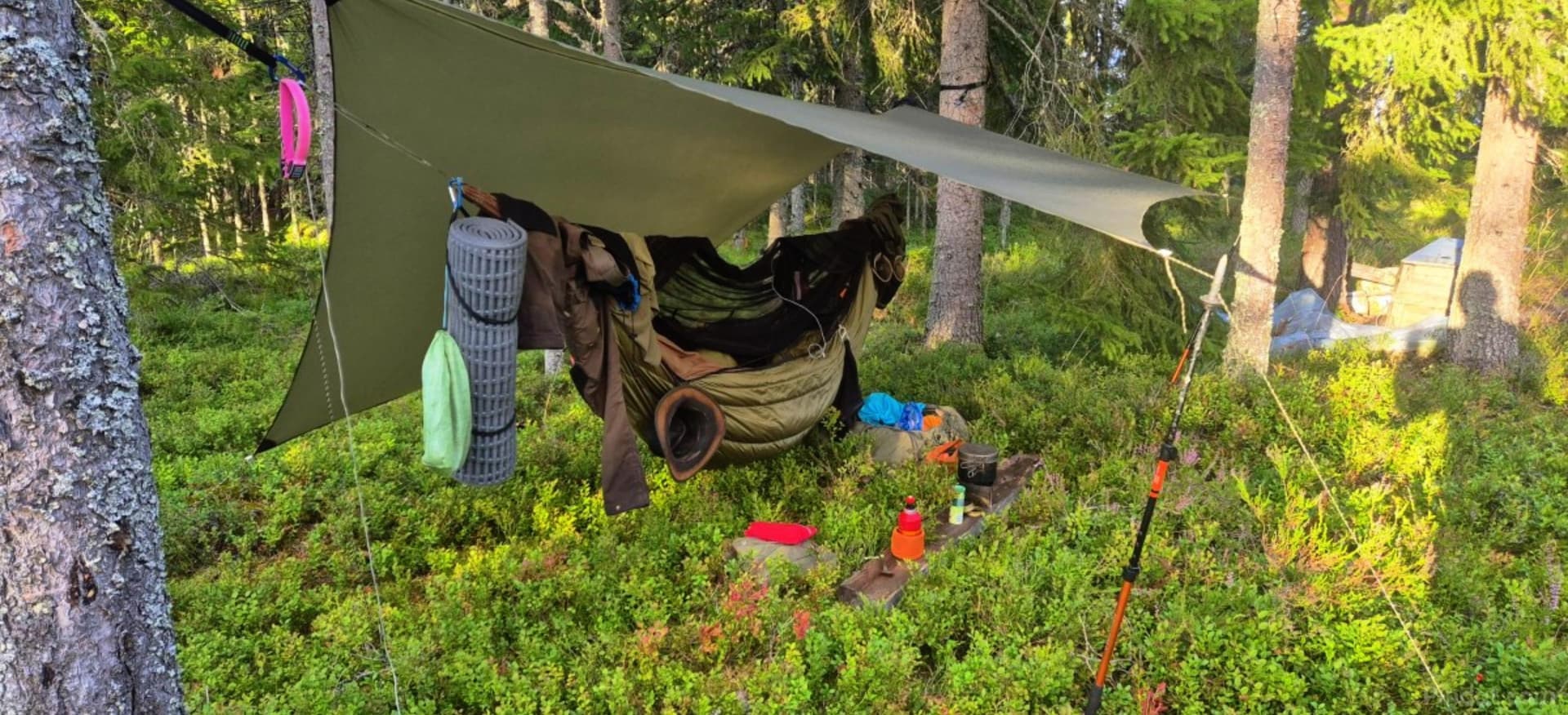
| Primary shelter | Hammock + tarp |
| Above treeline | Tarp over trekking poles, roll mat on the ground |
| Pack weight | 17–22kg depending on water and food load |
| Historic significance | First recorded solo thru-hike of the Romboleden in one continuous journey |
Before the Trail: Hard Work, a Long Recovery, and the Right Moment
Hindek spent his career in transport. He worked hard for a long time. After selling the business he had more time and more urgency than most people experience together. A double pulmonary embolism had given him a specific kind of clarity about how to spend the years that came after. The St. Olavsleden two years earlier had been the first test. The Romboleden was the continuation.
"I've always worked hard. After selling my business I started travelling. This route was a follow-up to the St. Olavsleden I walked two years earlier. Historically, it belongs together — King Olaf walked the Romboleden four years before the St. Olavsleden, when he was fleeing from Trondheim to Köping to go into exile in Russia. So for me it was completing a historical circle." — Hindek
Before the trail proper began, he spent time volunteering at a farm in Sweden, physical outdoor work that eased the transition from ordinary life into the rhythm the trail would require. By the time he shouldered his pack in Trondheim, the body was already moving. The mind had already begun its shift.
The Romboleden: Sweden's Oldest Trail and Its Long Absence
The Romboleden is not simply a long walk. It is one of the oldest routes in Scandinavia, older, Hindek points out, than the St. Olavsleden, and it spent centuries largely forgotten before a revival effort began to mark and restore it.
"The Romboleden is a very old route, older than the St. Olavsleden, but it had fallen into obscurity. They are trying to put it back on the map now, but it is not fully finished yet. I was the first to walk it in one go." — Hindek
'Not fully finished' is understated. The Romboleden is what Hindek describes as a route still in development, maintained by volunteers, altered each year by snow and rain and the growth of vegetation over paths that see almost no foot traffic. Trail markers disappear for an hour at a time. Paths close up when nobody walks them. What is marked on one year's GPS track may be impenetrable forest the following season.
"It's done by volunteers and it takes time. Because of snow and rain, the landscape changes every year. If nobody walks it, the paths close up. Sometimes I was a few kilometres off on the GPS. But that's part of the adventure." — Hindek
On one occasion he followed red marks on trees for some time before realising they were a forestry owner's private boundary markers, not trail blazes. It cost him several kilometres of detour around a lake. On other sections he waded knee-deep through rivers because no bridges existed. In the northern bog sections he stamped ankle-deep through marsh for hours at a time.
"Sometimes you walk an hour without seeing a single marker. You need to be able to trust your navigation. It is genuinely a route still in progress." — Hindek
The Historical Context: A Circle Completed
The Romboleden's history runs deeper than most hikers know. Hindek had spent time with this history before he walked it, partly because understanding why a route exists changes how you move through it.
Olaf Haraldsson, King of Norway from 1015 to 1028, was the king who forcibly Christianised Norway and who, after being deposed by Cnut the Great in 1028, fled his kingdom. The route he is believed to have taken ran from Trondheim, south through Sweden, through Dalarna and down to Köping on the western shore of Lake Mälaren, where he borrowed boats to sail east toward Russia and exile. That route, now largely forgotten, is the Romboleden.
Four years later, in 1030, he returned to reclaim his throne. He was killed at the Battle of Stiklestad on 29 July 1030. His body was carried to Trondheim. Miracles were attributed to him. He was canonised as St Olav within a year. The route that carried people toward his shrine at Nidaros Cathedral, north from the Swedish lowlands to the Norwegian coast, became the St. Olavsleden.
Walking the Romboleden south, then the St. Olavsleden north, completes the king's journey in both directions. Hindek walked the St. Olavsleden first, two years earlier. The Romboleden was the other half.
"Historically this piece belongs with the other: King Olaf walked the Romboleden four years before he took the St. Olavsleden, when he fled from Trondheim to Köping to go into exile in Russia. So it was a historical round trip." — Hindek
What the Trail Is Actually Like
The Romboleden runs from Trondheim southward — the direction Hindek walked it, the direction Olaf fled. The route begins in urban Norway and within two days climbs onto the open highland of Herjedalen, the territory between Norway and Sweden, above the treeline.
"I started in Trondheim, in the city. After a day and a half you go right onto the highlands and end up in Herjedalen, the area between Norway and Sweden. There you go above the treeline. You can go days without trees, without internet, without anything. Sometimes you stamp through bog up to your ankles for hours. Rivers have no bridges, sometimes you stand knee-deep in water to cross." — Hindek
The isolation on the northern sections is total. He went two or three days at a stretch without seeing another person. Wildlife replaced human contact, reindeer on the highland, elk and badger further south in the Swedish forests. He walked through documented bear territory and found evidence (a dropping in the path) but no bear. Wolves and lynx are present in the Swedish forest sections. In 46 days, he encountered none of them directly.
"Sometimes I walked two or three days without seeing anyone. You see a reindeer, or birds, but no people. Further south there are more animals — elk, badgers. I walked through bear country. I found a dropping but no bear. Wolves and lynx exist there too, but they are so shy you simply don't see them. Local people who have lived there their whole lives have sometimes never seen a bear." — Hindek
The south is different in character, the deep Swedish forests giving way gradually to summer farms, small villages, and the recognisable agricultural landscape of Dalarna and Västmanland that tourists to Sweden typically know. After the bog-and-highland northern section, arriving in that landscape feels like a return.
The Best Moment
"The highland in Herjedalen. You can see the same mountain for three days and feel like you're not making any progress. But the silence, the stars, the clear water, it stays with you. You feel very small without phone signal. That is the point." — Hindek
Why He Walked South and Why August
Hindek began in Trondheim and walked south to Köping. This is the direction that most Romboleden walkers have not completed, most of the trail's sparse documentation treats Köping as the start. His choice was deliberate.
"I started in Trondheim and walked south. This was a strategic choice: I was walking with the weather. Autumn was coming up behind me. I walked mostly in a t-shirt with short sleeves." — Hindek
August was the ideal month for the same reason. Scandinavian weather is stable in August; September brings cold quickly to the northern sections, and in the higher terrain snow can arrive before the month ends. Starting at the northern end in August and walking south meant he was ahead of the deteriorating conditions rather than walking into them.
Hooked on the Hammock: Why it was ideal for the Romboleden
The hammock is the element that most people ask about first. Hindek's answer is practical and clear.
"A hammock is comfortable and you have no problems with the ground, you can hang above scrub, rocks, or wet soil. With a tent you always need a flat piece of ground. I had one birch tree that bent a little and I nearly woke up with my backside on the floor, but otherwise it was fine." — Hindek
The question everyone raises about hammock camping on a trail like the Romboleden is the Herjedalen highland problem: no trees. His solution was the one that experienced hammock campers develop for exactly this terrain.
"On the highlands without trees I used my tarp as a ground shelter, supported by my trekking poles. I didn't use the underquilt then, I slept on a good old roll mat, which is also heat-resistant and works as a seat during breaks." ** — Hindek**
The freedom the hammock system gives on a route this long is structural. No site selection problem. No searching for flat dry ground at the end of a hard day. No tent to pitch in the dark. Any two trees at the right spacing are a campsite.
"My only planning is 100 kilometres per week, 15 to 20 kilometres a day, which leaves room for a rest day. Because I have everything with me, I have the ultimate freedom to sleep wherever I want." — Hindek
100 Kilometres a Week: The Philosophy of a Floor, Not a Ceiling
Hindek is not a training plan person. His preparation for the Romboleden was, in his own account, essentially nothing.
"Actually no preparation at all. I just packed my backpack and started. The first days are heavy, but after that it goes by itself." — Hindek
What he had instead of a training plan was a structural rule: 100 kilometres per week. Not as a target to chase but as a floor below which the trail would not fit the time available. At 15 to 20 kilometres per day over six walking days, there is room for a rest day each week and margin for the harder stages without producing a race.
The effect of that rule is psychological as much as physical. It removes daily pressure — you are not trying to maximise each day or optimise each stage. You are maintaining a rhythm. The rhythm carries you. The destination arrives when it arrives.
"This approach takes the pressure off. It makes the experience more important than the goal. If you travel with no expectations, you can't miss anything." — Hindek
The pack weight, between 17 and 22 kilograms depending on food and water, is heavier than most modern long-distance hiking advice recommends. Hindek is sanguine about this.
"I'm not a gram-chaser. After a while you don't notice a kilo more or less. The first days it's heavy, but your body adapts." — Hindek
The Gear: What 46 Days Across Scandinavia Actually Requires
Hindek's kit list is the product of two long Scandinavian trails, not a marketing catalogue. Every item has a specific reason. Some of the choices are counterintuitive until he explains them.
| Category | Item / Brand | Hindek's reasoning |
|---|---|---|
| Shelter — hammock | Lesovik hammock + tarp | Comes with a 'sleeve' fitting — full system assembled in under 3 minutes. Simplicity matters after a long day. |
| Insulation — underquilt | Cumulus down underquilt | Down over synthetic for its weight and pack size. 'Synthetic lets cold through after a few hours. Down doesn't.' |
| Insulation — topquilt | Cumulus down topquilt | Same reasoning. Weight and compression both critical at 900km. |
| Above treeline — ground sleep | Tarp rigged over trekking poles + roll mat | On treeless fjell: tarp as ground shelter, trekking poles as poles. Roll mat for insulation and as a seat on breaks. |
| Footwear | Meindl leather boots — no Gore-Tex | Gore-Tex stops breathing after weeks of use, saturated with sweat and fat. Leather breathes and dries faster. No blisters in 46 days. |
| Pack | Fjällräven (2.6kg empty) | Heavy empty but near-indestructible in dense scrub and bog. Not a gram-counting decision, a durability decision. |
| Cooking | Trangia spirit stove | Spirit alcohol sold in every Scandinavian supermarket. No gas canister logistics. Can see exactly how much fuel remains. |
| Navigation | Garmin eTrex 30 (AA batteries) | Batteries you can buy anywhere. Phone stays on flight mode to preserve charge. Never rely on a single device. |
| Fire & tinder | Mora knife (€36) + ferrocerium + tampons | Tampons: individually plastic-wrapped, always dry, and the cotton fibres are perfect tinder. Pre-warm the spirit bottle above a lit tampon at below-zero temperatures. |
| Water | Waterfilter + 3L carried capacity | Filtered wild sources throughout. Carried enough for 5–6 days of food between resupply. |
The boot decision, the most interesting call
The Gore-Tex boot orthodoxy in long-distance hiking is almost universal. Hindek rejects it, and his reasoning is worth quoting in full.
"I deliberately chose leather Meindl boots without Gore-Tex. Gore-Tex stops breathing after weeks of hiking, it gets saturated with sweat and fat and your feet start falling apart. Plain leather stays breathable and dries faster. That is the right choice for a long route." — Hindek
The tampon hack — for below-zero mornings
This one earns its own paragraph.
"I always carry tampons. They come individually wrapped, which means they are always dry, no matter the conditions. Pull one apart and the cotton fibres are perfect tinder. Light it, hold the bottle of spirit above the flame to pre-warm it. Works perfectly down to -7 degrees." — Hindek
Navigation, spreading the risk
On a trail where the markers disappear for an hour at a time and your GPS track may predate last winter's landscape changes, navigation is not a background concern.
"Don't rely only on your phone. Keep it on flight mode the whole time, otherwise it's constantly searching for masts that aren't there and the battery is empty immediately. I use a Garmin eTrex 30 on AA batteries. You can buy those batteries in any supermarket anywhere. Spread your risk. I once met a family in the mist who were relying only on their phone and had no signal left. That is not smart." — Hindek
The St. Olavsleden: The Other Half of the Same Journey
Two years before the Romboleden, Hindek walked the St. Olavsleden, the 580-kilometre Baltic-to-Atlantic pilgrim trail from Selånger on Sweden's coast to Trondheim. That trail follows the route taken by King Olaf after the Battle of Stiklestad, the return journey from exile, the one that ended at Stiklestad and then in sainthood.
The Romboleden is, historically, the outward journey, the flight into exile, the route taken four years before the St. Olavsleden's events. Walking both, in sequence, traces the full arc of the story.
The St. Olavsleden is better suited as a first Scandinavian long-distance trail. It is well-marked, has regular facilities, and follows a clear and well-documented route. The Romboleden requires the confidence that comes from having already done something like it.
"Don't start with the Romboleden as your first long-distance hike. Start with the St. Olavsleden, it's well-marked and has facilities everywhere. The Romboleden is still too much of a search route. In Norway I walked a whole day through mud in cow hoof-prints, that's hard with 20 kilos on your back. I loved it. But you have to be able to cope with that." — Hindek
The Arrival in Köping
After 46 days, Hindek arrived in Köping. The local church had been following his progress. The pastor was there. He was formally registered as the first person to have completed the Romboleden in a single continuous journey, and was, in a ceremony that the Swedish church takes seriously for its pilgrim routes, officially received at the trail's end.
The moment was shared widely on Swedish social media, but Hindek is already thinking about the next adventure.
The Romboleden: Practical Details for Anyone Thinking About It
Trail stats
-
Distance: approximately 900km, Trondheim to Köping (or reverse)
-
Duration: 6–10 weeks. Hindek: 46 days at ~100km/week
-
Start: Trondheim, Norway, or Köping, Västmanland, Sweden (1.5hr from Stockholm by train)
-
Terrain: open highland bog (Herjedalen) in the north; boreal forest through Dalarna; cultivated lowland in the south. Genuinely wild in the northern sections.
-
Marking: red and grey St Olav symbol. Inconsistent, some sections unmarked for an hour at a time. Navigation experience essential.
-
Accommodation: wild camping essential. Church-to-church staging in the south; self-sufficient camping in the north and mountain sections.
-
Best season: August (northern sections). The August start in Trondheim puts you ahead of autumn weather as you travel south.
-
Navigation kit: offline GPS tracks plus a backup device on AA batteries. Do not rely on phone signal.
-
Pilgrim's passport: available at Köping. Stamps at churches en route. Completion diploma at the far end.
-
Recommended prerequisite: the St. Olavsleden (580km, better marked, more facilities). Do that first.
FAQ about the Romboleden
Is the Romboleden suitable for a first long-distance hike?
"No. At the moment experts advise against the Romboleden as a first walk. The markings are incomplete and the terrain requires navigation experience. The St. Olavsleden is a better alternative for beginners." — Hindek
What is the best time to walk it?
August, starting from Trondheim and heading south. Stable weather, and you travel ahead of autumn rather than into it.
How heavy is the pack?
"Between 17 and 22 kilos depending on water and food, usually food for 5–6 days. My pack weighs 2.6 kilos empty, but it's indestructible. I'm not a gram-chaser." — Hindek
Can you wild camp everywhere?
In Sweden, yes, Allemansrätten grants one to two nights' camping rights anywhere on uncultivated land unless it’s someone’s property, and make sure to keep your distance from houses. The Norwegian equivalent applies north of the border. On the open highland sections above the treeline, a tarp and trekking poles replace the hammock. Plan your treeline crossings a day ahead. Ready for your own Swedish trail? The Romboleden is one of Europe's great long-distance trails — and one of its least known. If it is on your list, the place to build the confidence and hammock-camping knowledge to do it is the Hammock Trail: Sweden. Six nights in Glaskogen's boreal forest, guided, with all gear provided. The system Hindek used for 900 kilometres starts here. Departure dates at www.hammockhaven.eu/trips/the-hammock-trail-sweden