What is Slow Travel? Why Missing Out is the Best Way to Experience Nature
Last modified on 30 May 2026
Reading time 6 minutes
Discover the transformative power of slow travel. Learn why slowing down, ditching strict itineraries, and embracing nature helps you experience more by doing less.
The trip that looked great on paper and left you empty
Most people have taken it at some point. Seven cities in nine days. Four countries in a week. The holiday that was carefully optimised, every morning somewhere new, every afternoon another landmark, every evening a different restaurant, and that left you, somewhere around day five, quietly exhausted in a way that felt somehow worse than not having gone at all.
The photographs were fine. The itinerary was technically impressive. But there was almost no moment, looking back, where you actually stopped. Where the place had a chance to become something more than a backdrop. Where you could feel it rather than just visit it.
This is the natural endpoint of speed-maximised travel: you see more and experience less. The two are not the same thing, and the faster you move, the wider that gap grows.
Slow travel is the correction. Not a trend, despite what the travel press says, it's been there as long as people have been exploring the world for reasons other than efficiency. What's changed is the recognition that deliberately slowing down is not the consolation prize for people who can't afford to go further or faster. It's the better version of the thing.
What slow travel actually means in practice
The definition is less about pace and more about attention and focus. Slow travel means giving a place, and your own experience of it, enough time to become something.
It means waking up in the same forest two mornings in a row and noticing what's different about the light. It means following a trail without a fixed end time and seeing where the afternoon actually takes you. It means sitting with the discomfort of having nothing scheduled for an hour, and then discovering what fills that space when you let it.
It is, in a real sense, the opposite of everything that professional life optimises for. Which is exactly why it works.
Research on the psychology of travel experiences backs this up clearly. The studies on hedonic adaptation, the well-documented human tendency to rapidly adjust to new stimuli, show that the pleasure derived from novel experiences peaks early and declines quickly as we move on. The solution is not more novelty but more depth: spending enough time with a single experience that it moves through the initial hit and into something more lasting.
A week in one forest, or moving slowly through one mountain range, produces memories that are encoded differently and more durably than a week of rapid movement through many places. You remember what it smelled like. You remember specific conversations and moments of laughter. You remember the particular quality of a morning that you were still there to see.
The specific alchemy of moving through nature slowly
There is a version of outdoor adventure that is also speed-optimised: the summit-focused hike where the mountain is the goal and the walk is the cost. The trail run where the time is the point. The packaged multi-country trek where the distance covered is the measure of success.
These are valid activities. But they share something with speed-maximised city travel: the experience is subordinated to the achievement. You move through the landscape rather than with it.
Moving slowly through nature, walking at a pace that allows conversation, stopping when something warrants stopping, making camp early enough to actually inhabit the place before dark opens a different register of experience entirely.
What you notice when you slow down
The forest is not a backdrop when you spend enough time in it. It becomes a place with its own logic: the birds that appear at certain times of day, the way sound travels differently near water, the micro-weather of a clearing versus a canopy, the exact moment the temperature drops in the evening. None of this is available at speed. All of it is available when you're moving slowly enough to pay attention.
What happens to conversation
Long, unhurried days in wild terrain produce a specific quality of conversation. Not the compressed, agenda-driven exchanges of professional life, but the kind that spontaneously starts nowhere and arrives somewhere unexpected. The walk gives conversation a rhythm and a permission. There's no awkwardness in silence on a trail. The thinking happens out loud because the environment is conducive to it.
What happens to you
The most consistent thing people report after a multi-day slow trip in nature is a change in their relationship to time. Not that time slows down, that's imprecise, but that the experience of it becomes richer. More hours of the day are occupied with actual sensation rather than the management of sensation. You arrive back not just rested but somehow more yourself.
Why a hammock is the physical embodiment of this idea
The hammock is not incidental to the slow travel argument. It is, in a literal and philosophical sense, the right piece of equipment for it.
A hammock requires you to stop. Not as a concession, but as its entire function. You don't pass through a hammock. You arrive in it. You settle. You look up and relax, having it set up in less than 2 minutes for a lunch stop.
The moment of getting into a hammock after a day of walking, the specific give of the fabric, the slight oscillation as you find your weight, the view of whatever is above you resolving into focus, is a moment of enforced presence. There is genuinely nothing else to do. You are there.
Pitched between two trees in a forest or on a mountain slope at the end of a day's walking, a hammock makes the case for slow travel better than any philosophy could. The whole point is to be here, in this specific place, for long enough to actually feel it.
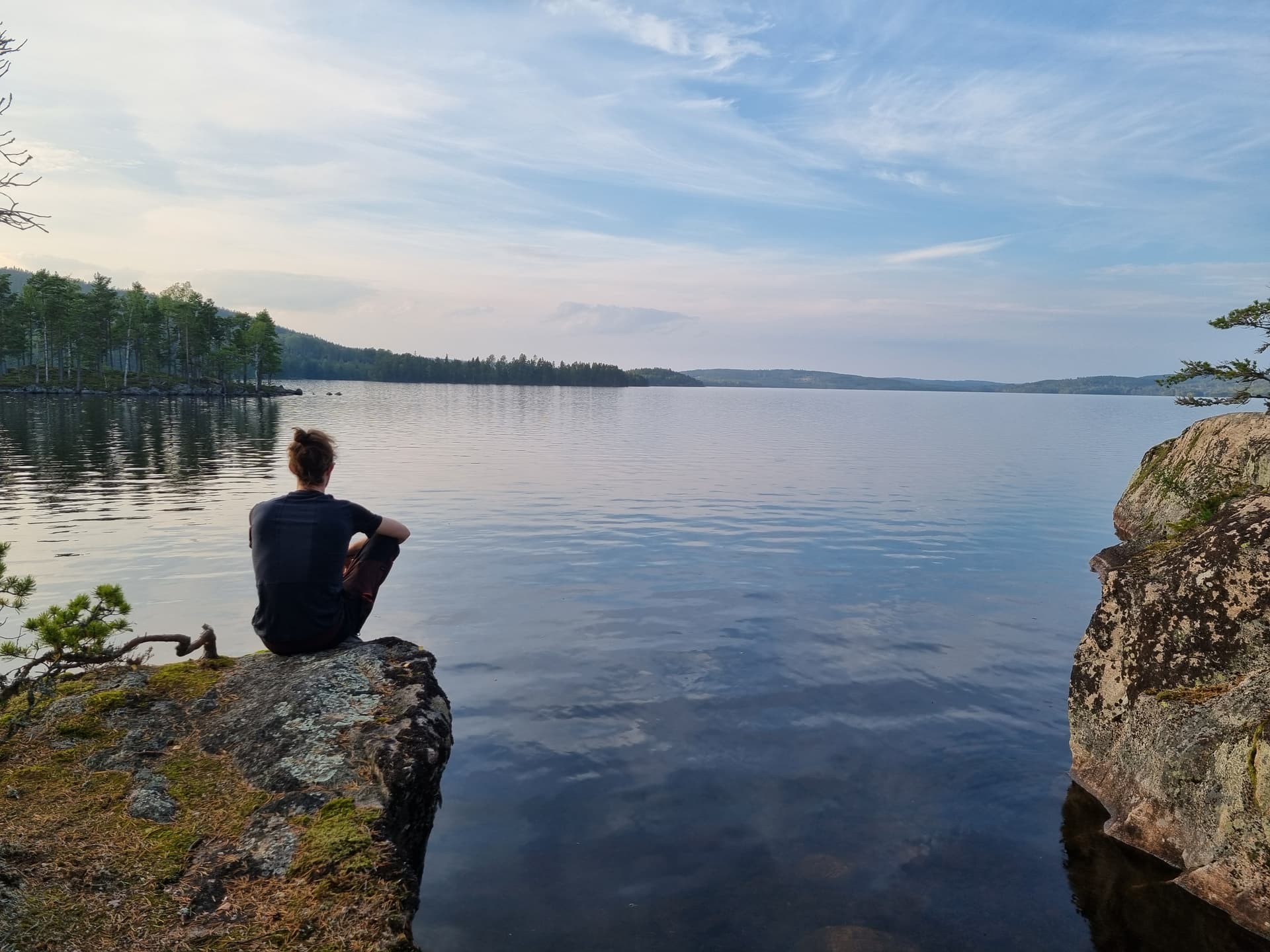
Woke up in Sweden, sun on my face as the early morning had started. Some had already gone out to prepare breakfast, picking blueberries from the forest floor. The day began slowly: a cup of coffee and a blueberry acai bowl, nothing scheduled, nowhere to be for another hour.
The slow travel checklist: what to actually do differently
Slow travel isn't passive. It requires active choices to resist the pull toward optimisation. A few concrete ones:
Leave white space in the itinerary
Not every hour needs a plan. Planned spontaneity isn't spontaneity. Build in afternoons with no specific agenda and see what they produce. The best moments on most outdoor trips happen in the unscheduled gaps. On the Sweden route, daily distances are kept deliberately flexible, and an optional free afternoon is part of the design, not an afterthought. If the light is extraordinary at 4pm, there's room to stop.
Resist the urge to cover ground
Distance is not the measure of a good day outdoors. A four-hour walk that includes a long rest at a viewpoint, a swim in a river, and a conversation that runs over lunch is worth more than an eight-hour march that ends in camp just before dark.
Put the camera down more than you pick it up
Photographs are good. They're also a way of managing experience rather than having it. The act of framing and capturing creates distance between you and the thing. Choose regularly, deliberately, to look without the phone.
Let the place set the pace
Pay attention to what the environment is actually offering rather than what the plan says you should be doing. Rain is a reason to stop and make something warm and wait. An unexpected view is a reason to be late to camp. The trail isn't going anywhere.
A word on JOMO and why it's not what you think
The travel industry coined 'JOMO', Joy of Missing Out, as the antidote to FOMO, and the phrase has become so widely used that it now carries a faint whiff of marketing. But the underlying idea is real.
There is a genuine and specific pleasure in being somewhere that is not optimised, that you haven't researched into submission, that doesn't have a rating or a queue or a best-practice itinerary. The pleasure of missing the other thing is real, and it compounds over the duration of a slow trip.
By day three of moving slowly through a wild landscape, the question of what else you could be doing, the background anxiety of the optimiser, has faded in the adventure. What remains is the particular texture of where you actually are. That is the destination that slow travel is trying to reach. It's not a place on a map.