Why the Albanian Alps are Europe's new adventure hotspot and how to hike them
Last modified on 6 Jun 2026
Reading time 6 minutes
Ditch the resorts for the Albanian Alps. Discover the ultimate guide to hiking the Accursed Mountains, exploring the Theth Valley, and hammock camping in the wild.
The destination shift that's already happening
Something is changing in how a generation of travellers thinks about holidays. Not across the board, the beach resorts are still full and the Instagram pools still have queues. But among a specific type of traveller, the ones who come back from a trip wanting to tell you a story rather than show you a picture, a different conversation is happening.
They're talking about the Balkans.
And increasingly, they're talking about Albania.
Not the Albania of vague Cold War associations. Not the Albania of outdated travel advisories. The Albania of towering mountain ranges, medieval stone villages, crystalline rivers, and landscapes that look like they've been untouched since before the concept of tourism existed. Because in many places, they have.
What Northern Albania actually looks like
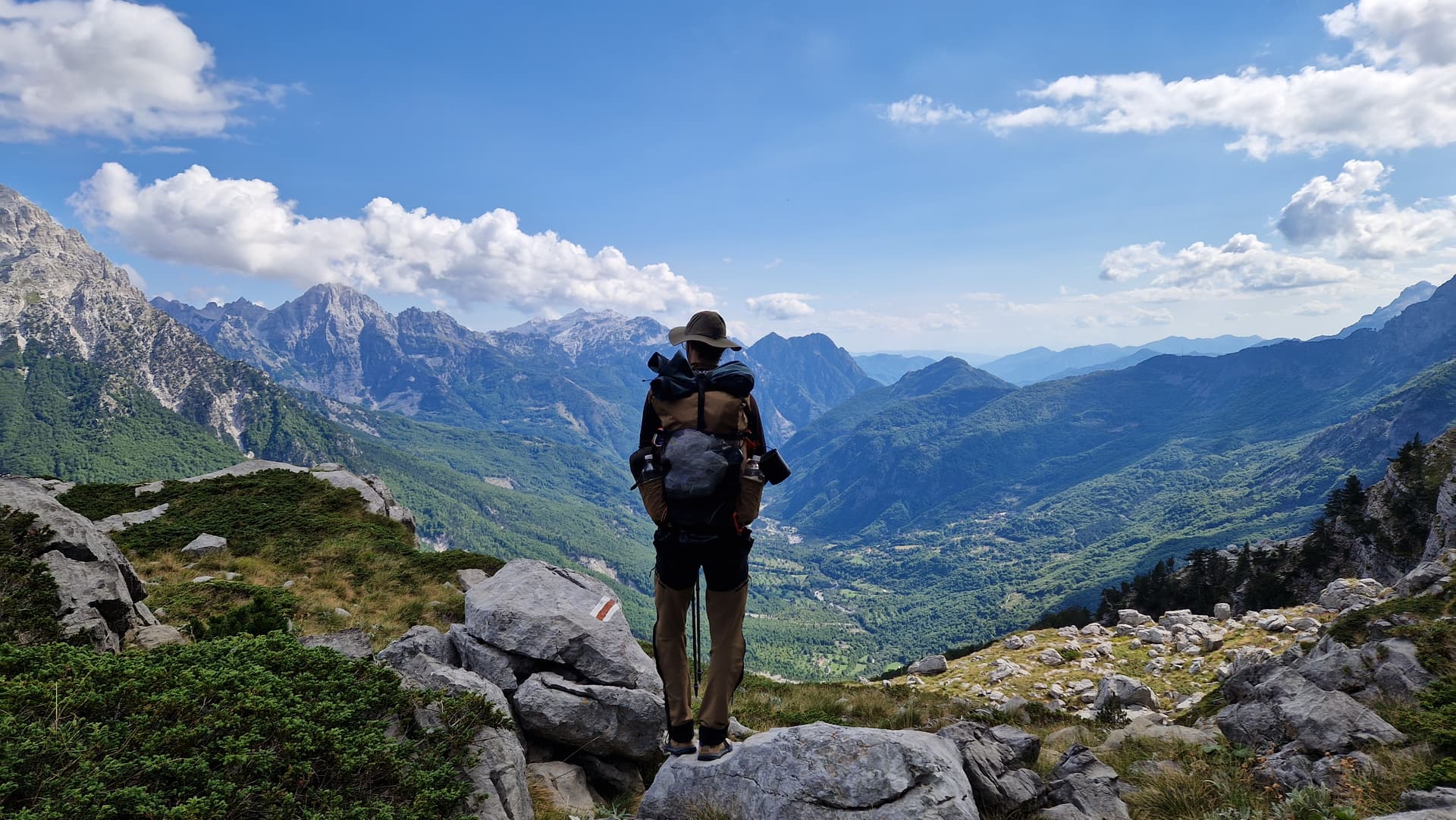
The Albanian Alps, known locally as the Bjeshkët e Namuna, or 'Accursed Mountains', run along the northern border of Albania into Montenegro and Kosovo. The name comes from their impassability, not their character. On the ground, they are extraordinary: jagged limestone peaks rising above deep river valleys, with waterfalls visible from the trail and villages that appear to have grown directly from the rock.
The Theth valley sits at the heart of this landscape. A single road winds in from the southwest, and once you're in, the modern world genuinely recedes. There is mobile signal in parts, but the mountains are large enough and the trails long enough that most of the day is spent without either distraction or obligation.
The Hammock Trail Northern Albania starts in Lepushe, taking an off-the-beaten-path line that stays well clear of the main trekking corridor. The trail passes through the Valbona valley area, hiking toward the Pyramid Pass, through forest and ridge terrain that most visitors to this region never reach. One of the most remarkable overnight spots on the route is beside the Blue Eye, a natural spring of extraordinary clarity that draws day-trippers from miles around but empties by evening. Because the route is hammock-based, you stay when everyone else has left. The spring, the silence, and the trees are yours.
Early on the trip, before the first major climb, we hike to a waterfall where a man lives alone in the old way. The lead mountain guide actually knows him and they’re friends!
Why this destination is still underrated (and won't be for long)
Albania has been appearing on 'hidden gem' lists for several years now, which means it's no longer entirely hidden. But it remains remarkably undeveloped for adventure tourism compared to its Balkan neighbours.
Slovenia has the Julian Alps and decades of hiking infrastructure. Montenegro has been discovered. Croatia's coast is firmly on the mainstream map. Albania's north is still behind the curve, by a few years at most.
The trail infrastructure is improving rapidly. The villages are beginning to offer accommodation. The road into Theth was paved (controversially, among those who loved the challenge of the unpaved version). This isn't a destination that will stay under the radar. The question is whether you go before it tips, or after.
The culture layer that changes the adventure
Adventure travel in Albania isn't only about the landscape. The cultural context is what makes it different from hiking in the Alps or trekking in Scandinavia.
The villages of northern Albania are governed, formally or informally, by the Kanun, an ancient code of customary law that emphasises hospitality above almost all else. A stranger arriving at a household in the Albanian mountains is, by tradition, owed protection and food. The 'besa', a word that translates roughly as 'pledge of honour', underpins this. You are safe here, and you are welcome here, in a way that is old and serious and not performative.
The food served in village guesthouses reflects this. It's local, seasonal, and generous: lamb, mountain cheese, cornbread, wild herbs.
At the end of one of the later hiking days, arriving in the town of Çerem, the group was taken in by a guesthouse and joined for breakfast the following morning. Around the table were other hikers the group had briefly crossed paths with days earlier in Theth. What could have been a functional meal became something else: a reunion between adventurers who'd shared the same mountains, at the same time, without quite knowing it. That's Albania. The place guides encounters that feel like they were arranged.
What the physical challenge actually looks like
Albania's mountain trails are not technical climbs. You do not need specialist equipment or mountaineering experience. But they are genuinely demanding.
The Hammock Trail: Northern Albania covers 102km over 8 days, averaging around 13km per day. The hikes take between 5 and 8 hours, including breaks, with total elevation across the trip of approximately 15,000m, averaging 1,850m of combined ascent and descent per day. On a typical day, that might mean 1,200m up and 600m down.
A good base level of fitness and the resolve to push through harder moments are both important. The terrain is varied, and the conditions are sometimes demanding. But this isn't a race, and the pace is set to the group rather than the clock.
How to prepare
The best preparation is practical: incrementally pack your backpack to around 15–20kg of kit and walk. Around your town, with friends, over a few weeks before departure. You don't need a structured training plan. You need to know how your body responds to sustained effort under load. The Albanian mountains will ask that question; it's worth having some answer ready.
Weather and conditions
The valleys are warm in summer; the ridges are not. Expect fast-changing conditions at altitude, cold mornings and evenings later in the season, and UV radiation that intensifies significantly above 2,000m. Waterproof layers are non-negotiable. Multiple base layers and the ability to add or shed quickly as conditions shift are what determine comfort on the harder days.
Hammock camping in a mountain environment
The specific choice to hammock camp in this environment isn't incidental; it changes the relationship you have with the landscape.
Sleeping in a tent in the mountains is fine. You're warm, you're covered, and you're there. But sleeping in a hammock between two trees on a mountain slope, with nothing above you but the nylon of a tarp and everything below you falling away into a valley, is a different experience entirely.
The sound travels differently at altitude. The air is colder and cleaner. The stars, in an area with almost no light pollution, are a different sky from the one you know.
Two nights stand out particularly on this trip. The first is in the forest above the valley of Nikç, the hillside drops away beneath the trees, and the view across the valley from your hammock, in the last light, is the kind of thing that's hard to describe without it sounding like an exaggeration. The second is beside the Blue Eye itself: a hammock-only overnight spot that no tent camper reaches. In the morning, before the day-trippers arrive, you can swim in the spring water beside the waterfall. That morning exists, on this trip, for no other reason than because you stayed.
Who goes on a trip like this?
The adventurers who book this trip don't all look the same. They range in age, background, and experience. What they tend to share:
- A growing frustration with holidays that require no effort and leave no memory
- An interest in the outdoors that hasn't yet been formalised into gear lists and route planning
- The sense that they want to go somewhere real, but uncertainty about how to do it alone
- A willingness to sleep outside, eat simply, and talk to strangers
Most adventurers have never done anything quite like this before. That's not a problem, it's the point. The learning curve is part of the experience, and it happens in company.
The practical bits you actually need to know
Getting there
Tirana's Mother Teresa Airport has direct connections from most major European hubs. From the airport, the group is transported by van to Shkodra, where everyone dines together on the first evening, the trip's natural start. If you arrive early and need picking up in Tirana itself, that's possible too. Transfer from the airport is included in the trip price. The official start time is 17:00.
What to bring
Albania's mountain weather is variable. The days are warm; the nights are cold. Layers are essential, waterproofs are non-negotiable, and broken-in hiking boots are the single most important piece of kit. For the full packing list, see the dedicated guide: What to bring for The Hammock Trail: Northern Albania
Group size and guides
The trip runs with a maximum of 10 adventurers, 2 Hammock Haven tour leaders, and 1 local mountain guide who knows this terrain in all conditions. Small enough to move fluidly, large enough to feel like a group.